I Didn’t Even Walk It
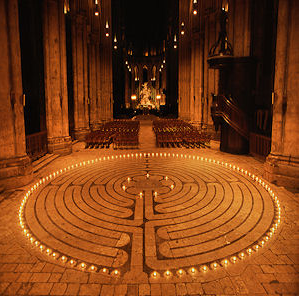
During my years as a pastoral counselor, I was a member of the American Association of Pastoral Counseling, and each fall, our regional chapter planned a retreat for its members. I helped with the planning several years. For one retreat we decided to borrow a large labyrinth painted on huge pieces of canvas. I had walked labyrinths on numerous occasions and found the experience one that invited insight, peace, and grounding.
We must have felt strongly that a labyrinth would be a valuable part of our program because getting it proved to be quite an undertaking. After our evening session, another woman and I had to drive approximately 90 miles from our retreat center in West Virginia to Arlington, Virginia. There we picked up the labyrinth that had been in use during the evening and took it to our retreat, a long drive into the night. The labyrinth was bulky to load and unload, to say nothing of laying it out on the floor and matching the sections, but we managed it.
At that point in my life, I was struggling with migraine headaches, and my doctor had not yet found the right combination of medications to make them manageable. When I got one, it lasted for much of a week, rendering me marginally functional. Pain medication took off the edge, if I was fortunate, but nothing made it go away. So, as you have probably guessed, a migraine slowly insinuated its way into my head during this late-night trip.
After too few hours of sleep, we opened the labyrinth the next morning for people to use, and I took my three-hour turn to be on hand to answer questions and lend support as people walked. What follows is the thank you letter I wrote to the person from whom we borrowed the labyrinth.
Dear Jane,
I want to thank you once again for making the labyrinth available to us. My question about the foolhardiness of our driving all that way on Friday night to get it has been completely dispelled.
We set up the labyrinth in one half of an indoor tennis court, so we had plenty of space, but not particularly aesthetic surroundings. (And, for the record, Sue [the driver] and l, without realizing it, carried in the center panel which we had been told was so heavy that only men could carry it!) We lit candles, played music, and made available scarves, and these, along with the reverence and expectancy of those who walked, created a sacred space.
Here are a few vignettes from my observation of walkers:
A mother and her six-year-old daughter walked together, holding hands some of the time. At one point they stopped. The mother stayed where she was while the daughter ran straight out of the labyrinth, took off the scarf she had been wearing and found another to her liking—a spontaneous act that disregarded all the “rules.” I helped her get it up on her shoulders so she wouldn’t stumble on it and then she ran back to where her mother was waiting and they resumed their walk. The mother told me later that she changed her mind and also walked it with her younger son who has a number of fairly severe emotional problems. She placed her hands on his shoulders to guide him and at the center moved her hands to his head and prayed silently for him.
There was a woman who obviously had studied dance who danced the whole way in and out and another who tied scarves to each wrist and waved the scarves in the air as she walked. One person stood in the center and wept. A man paused at each turning as if in prayer. Many people simply walked it slowly. Although they did nothing obviously unique it was easy to sense their total absorption in the process.
A man who was not a part of our group approached and said that he has read about labyrinths and is interested in them but has never walked one. He asked if he could walk. I gave him the little write-up a member of our group had prepared and after reading it he walked. When he finished, he said to me, “Just what the doctor orded.”
I observed a woman who had been walking, just sitting at the side. I happened to walk by her, and she said that she had never gotten to the center, so I sat down beside her. I asked her whether the experience might be metaphoric for her in some way, and she responded, “only my whole life!” She was waiting for her partner, hoping that they could walk it together. When her partner arrived, I watched them go in together. Her partner placed her hands on the woman’s shoulders and followed her. When they got to the center they embraced and stood there for a while. Later I noticed them coming out, holding hands and facing each other. I watched, mesmerized, the tandem movement of their feet as one walked forward and the other backward the entire way out.
The main sessions, which I missed due to responsibilities with the labyrinth, were about photography and finding new ways of seeing things. A number of people came in and quietly took pictures of candles, scarves, walkers’ feet, the finger labyrinth—I don’t know what all. It didn’t feel intrusive, but another way of participating.
All in all, it was a much more profound experience than I had anticipated. Your hours and hours of work to make the labyrinth a possibility is truly a gift to many people. Thank you again.
Sincerely,
Kathie
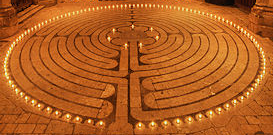
Only afterward did I realize that I had not actually walked the labyrinth myself. However, by sitting with it and watching others, I felt like I had. Then I noted that my migraine was gone—completely gone. Not even a trace left. I feared it was a momentary lull, and kept expecting the familiar throbbing to return, but it didn’t. No migraine had ever simply disappeared like that. This was beyond the scope of what I expected.
I had thought of the labyrinth as a spiritual tool for reflection, meditation, insight, and peace, but I’d forgotten that my physical body mattered too, that it could also be healed, even without walking.

Life is a labyrinth.
Yes, at least it can be if we are paying attention.
Thanks for sharing this beautiful story, so full of miracles–from the carrying of the heavy framework by two women, the relief of your migraine, to all the transformation which took place.
Thanks, Mary! It was sacred space for sure, even if it was just half a tennis court at a retreat center. I think of the prayerful intent of those who painted the pattern on huge pieces of canvas and were willing to let others use it, our willingness to make the late-night trip, the candles lit and the music played, and most of all the intent and openness of the participants who walked, danced, loved and prayed their way through the process. Part of me was astonished at my own (unasked-for) healing and part of me was not at all surprised.
Another beautiful story that is also a metaphor. You are so good at that!
Thank you, Kathie.
It probably comes with being a pastoral counselor, or maybe just a counselor–what we’re trained to do–find meaning/significance in the small things of life.
Wherever it comes from, it is a gift.
Thank you, Kathie. I really enjoyed your insight into “not even walking” the labyrinth.
Debbie, it’s been a long time since we’ve been in contact. Do you ever come to or through H’burg. I’d love to get together again.